Blue Leaf Auctions & Marketing

  • Home
  • About
  • Live Auctions
  • Online Auctions
  • Sellers
    • Fiduciary Services
    • Realtor Services
    • Hoarding Help
    • Charity Auctions
  • Blog
  • Contact Us

November 5, 2026 By BlueLeafAuctions

Real or Reproduction? How to Spot a True Vintage T-Shirt

Old concert shirts, faded souvenir tees and worn-in sports shirts are some of the hottest vintage clothing around. A real 1980s or early-1990s band tee can bring serious money, but reproductions are everywhere. These are the clues buyers check, and why no single clue is proof on its own.

1. Check the stitching on the sleeves and hem

Older tees usually have a single line of stitching on the sleeve and bottom hem. Double stitching became common from the mid-1990s on. Some transition-era shirts mix the two. Single stitch is a strong sign of age, but counterfeiters know it, so keep checking.

2. Read the tag

A sewn-in fabric tag points older. Tagless printed neck labels mostly arrived in the 2000s. Classic vintage blanks include Screen Stars, Hanes (including Beefy-T), Fruit of the Loom, Russell, Champion, Stedman, Velva Sheen and All Sport. “Made in USA” is common on 1980s and 1990s shirts. Production moved overseas mostly after 2000.

3. Feel the fabric and look at the fit

1980s tees tend to be thin, soft and a little longer. 1990s tees are boxier and heavier with wider collars. Decades of washing leave cotton soft, thin and unevenly faded in a way that is hard to fake.
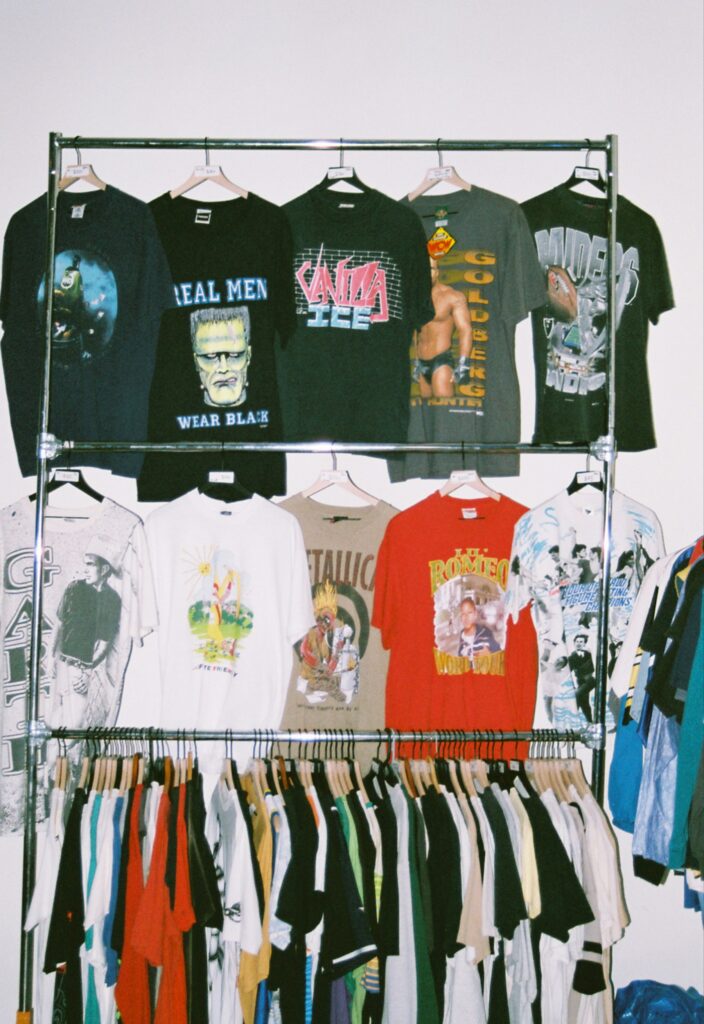
A rack of graphic t-shirts

4. Study the print

Older screen prints often crack naturally with wear. Puff, flocked and iron-on transfer prints also help date a shirt. Modern digital prints tend to look smooth and flat. Distressing that looks too even is a warning sign.

5. Find the copyright date

A small © year near the graphic tells you when the artwork was created, so it is the earliest the shirt could be. A shirt marked 1997 cannot be from 1992, but it could have been printed later.

Put the clues together

The stitching, tag, fabric, print, country of origin and copyright date should all point to the same era. When they disagree, be skeptical.

What sells best

Band and tour shirts, especially from the 1970s through the 1990s, lead the market. Harley-Davidson dealer tees, old sports and college shirts, and quirky local souvenirs, including plenty of Route 66 and Arizona tourist tees, are strong too. Wash vintage tees in cold water and hang them to dry.

From Blue Leaf

Found a closet of old tees?

We sell estates and collections across Arizona through live and online auctions. Every piece is photographed, cataloged and sold item by item to the highest bidders. Call 602-758-0865 for a free consultation, or browse our online auctions.
Sources

  • Unico13: How to know if a t-shirt is really vintage

Filed Under: Collecting Guides

November 5, 2026 By BlueLeafAuctions

5 Easy Upcycling Projects for Your Estate Sale Finds

Some of the best estate sale finds are the ones that need a little love. A sturdy old dresser, a tarnished lamp or a stack of mismatched china can become the favorite piece in your home with an afternoon of work. Here are five easy projects, plus one important rule before you start.

First: make sure it is not valuable as-is

Paint can wipe out the value of a quality antique or a signed mid-century piece. Look inside drawers and on the back for maker labels, stamps or signatures. If you find one, look it up before you pick up a brush, or ask us.

1. Paint a solid-wood dresser

  1. Clean it well with a degreaser and let it dry.
  2. Scuff-sand lightly so paint grips.
  3. Prime, then apply two thin coats of chalk or furniture paint.
  4. Seal with a clear topcoat and add new or polished hardware.

Safety note: paint made before 1978 can contain lead. Use a lead test kit from the hardware store and do not sand old paint you have not tested.

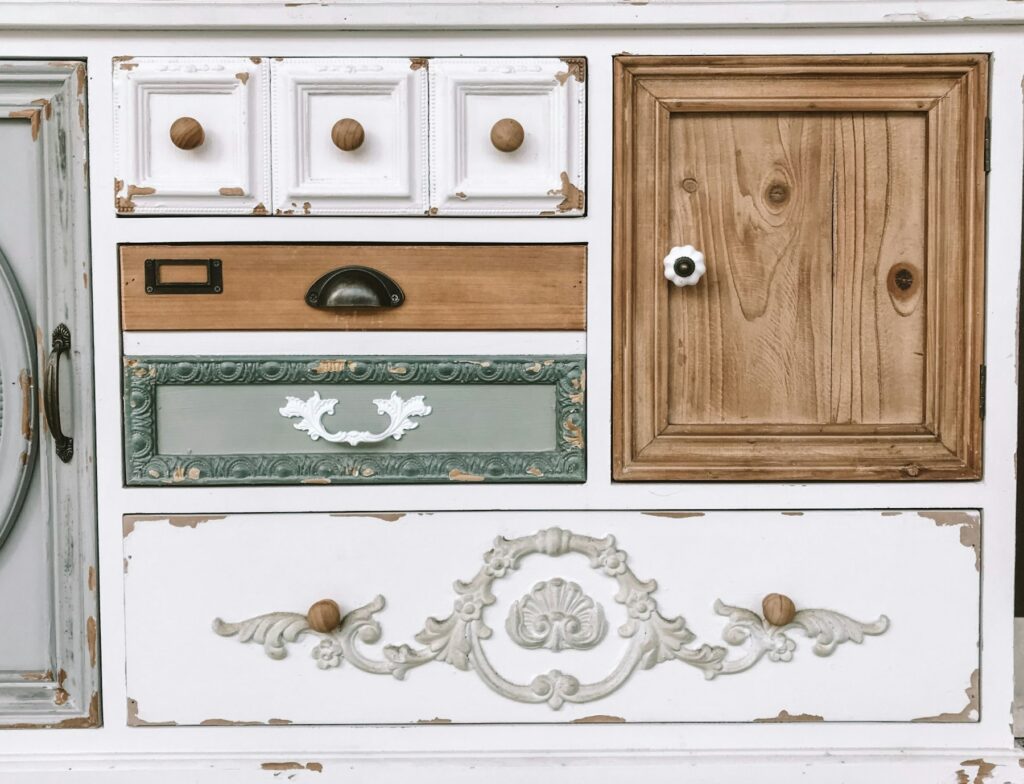
A painted vintage cabinet

2. Bring back old brass

Hold a magnet to it. If the magnet does not stick, it is likely solid brass. If it sticks, it is brass-plated steel, so clean it gently. Wash with mild soap and water, then use a brass polish. Many people now leave a little patina for a warm, aged look.

3. Reframe thrifted art

Original paintings and prints are a big trend right now. A fresh mat and a new or repainted frame can make an inexpensive find look gallery-ready. Old empty frames also make a great gallery wall, or you can have a mirror cut to fit.

4. Turn drawers and crates into shelves

A spare drawer or wooden crate mounted on the wall makes a charming shelf for a kitchen, bath or kid’s room. Use wall anchors rated for the weight.

5. Mix and match china

Mismatched vintage plates, cups and saucers make a beautiful collected table, and they are among the most affordable finds at any auction. Teacups and serving bowls also make lovely planters. Drill a drainage hole with a glass-and-tile bit, or keep a small pot inside.

From Blue Leaf

Looking for pieces to make your own?

We sell estates and collections across Arizona through live and online auctions. Every piece is photographed, cataloged and sold item by item to the highest bidders. Call 602-758-0865 for a free consultation, or browse our online auctions.
Filed Under: DIY & Upcycling

November 5, 2026 By BlueLeafAuctions

Vinyl Is Back: How to Tell If Your Old Records Are Worth Money

Records are back in a big way. In 2025, U.S. vinyl sales grew for the 19th year in a row and passed $1 billion for the first time since 1983, according to the Recording Industry Association of America. That means the crates of LPs in the garage or hall closet deserve a careful look before they go anywhere.

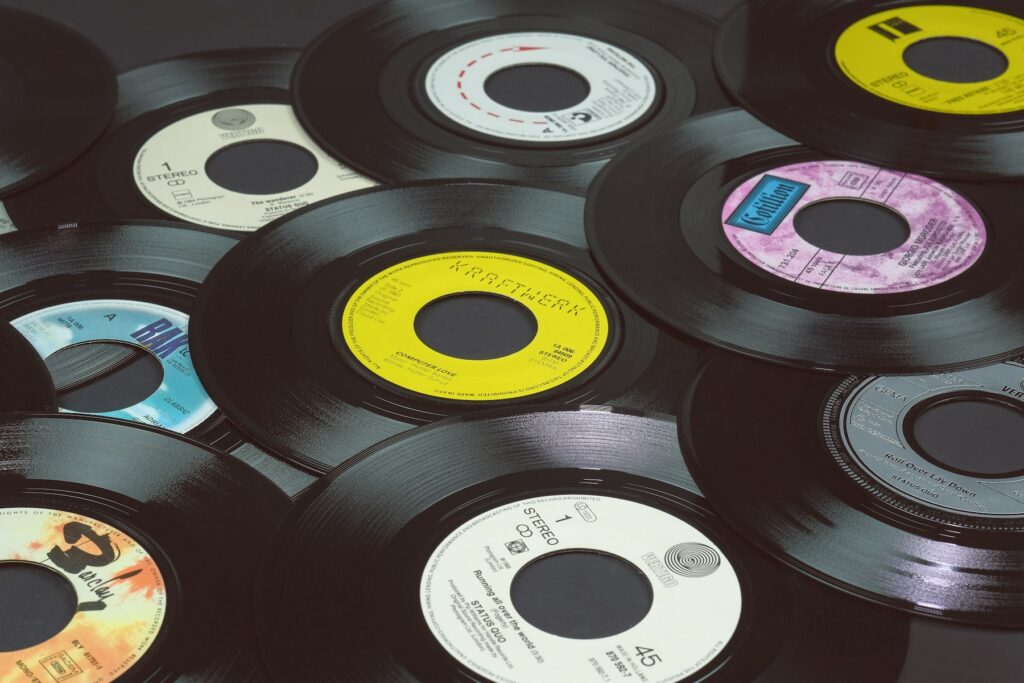
Vintage 45 rpm records

What makes a record valuable

  • Demand for the artist and album. Classic rock, jazz, soul, punk and early hip-hop are steady sellers. Common easy-listening albums usually are not.
  • Which pressing it is. An original first pressing is often worth much more than a later reissue of the same album.
  • Condition. This matters most. A scratched copy of a rare album can be worth less than a clean copy of a common one.
  • Everything that came with it. Original inner sleeves, posters, lyric sheets and stickers all add value. Promotional “white label” copies can be especially collectible.

How to identify the pressing

Look at the smooth band between the last song and the label, called the “dead wax” or runout. Etched letters and numbers there identify where and when a record was pressed. Type the album name and those numbers into Discogs, the large record database, to find the exact version and see recent sale prices for it.

How records are graded

Buyers use a standard scale, from best to worst: Mint, Near Mint, Very Good Plus, Very Good, Good, and Poor. Hold the record under a bright light. Light scuffs that do not affect play are acceptable for Very Good Plus. Deep scratches, warps and heavy wear drop the grade quickly.

An Arizona warning: heat warps vinyl

Never store records in a garage, shed or car here. Summer heat can warp a record in an afternoon. Keep them indoors, standing upright like books, in their sleeves and out of direct sun.

Don’t forget the gear

Vintage turntables, receivers and speakers from brands like Marantz, McIntosh, Technics and Pioneer are in high demand right now, even when they need service.

From Blue Leaf

Have a record collection to sell?

We sell estates and collections across Arizona through live and online auctions. Every piece is photographed, cataloged and sold item by item to the highest bidders. Call 602-758-0865 for a free consultation, or browse our online auctions.

Sources

  • Music Week: RIAA reports vinyl sales pass $1 billion
  • Discogs record database

Filed Under: Collecting Guides

November 5, 2026 By BlueLeafAuctions

Check Your Cabinets: 8 Vintage Pyrex Patterns Collectors Pay Up For

Vintage Pyrex is one of the most-searched kitchen collectibles in America, and it turns up in nearly every Arizona estate we sell. Most pieces are worth a modest amount, but a few patterns regularly bring hundreds of dollars. Before you donate that stack of mixing bowls, check them against this list.

8 patterns collectors pay up for

Prices below are recent sales compiled by Hunker. Real prices vary with condition and demand.

  1. Pink Butterprint (1960). Offered through a trading-stamp program and the rarest of the Butterprint colors. A set of three Cinderella casseroles with lids has sold for $800 to $1,250. Turquoise Butterprint is far more common.
  2. Pumpkin Butterprint (1965). Also a stamp-book premium with no regular production run. Three bowls recently sold for over $1,000.
  3. Atomic Eyes chip and dip (1950s). Two bowls joined by a metal bracket. Some pieces have no Pyrex backstamp. Complete sets have sold for nearly $600.
  4. Balloons chip and dip (1958). A promotional set. Complete and unused in its original box, one sold for $575.
  5. New Dots mixing bowls (1969). Orange, yellow and blue, plus a green 4-quart bowl added later. A full set of four has sold for over $400.
  6. Colonial Mist, all blue (1983 to 1986). The last opalware Pyrex pattern. Most sets alternate blue and white, so an all-blue set is the prize, at about $400.
  7. Pink Gooseberry refrigerator set (1956). Four dishes with lids. A set sold for $375. The lids matter.
  8. Friendship (early 1970s). Red birds on white. Mixing bowl sets have brought about $300.

How to tell what you have

  • Flip it over. Most pieces carry a Pyrex backstamp and a size or model number that helps match the pattern.
  • Count the set. Complete nesting sets, with every size and the original lids, are worth far more than single bowls.
  • Check the shine. Dishwashers dull the painted finish. Collectors call this “DWD” (dishwasher damage), and it lowers value. Hand-wash vintage Pyrex.
  • Keep the extras. Original boxes, brackets, carafes and lids can double a price.

The easy rule

Bright, glossy colors, complete sets and unusual patterns are the ones to set aside. Faded, scratched singles are still fun to cook with, and buyers at auction love them too.

From Blue Leaf

Not sure what is in the kitchen cabinets?

We sell estates and collections across Arizona through live and online auctions. Every piece is photographed, cataloged and sold item by item to the highest bidders. Call 602-758-0865 for a free consultation, or browse our online auctions.

Sources

  • Hunker: The 12 most valuable vintage Pyrex sets

Filed Under: Collecting Guides

November 5, 2026 By BlueLeafAuctions

Pink, Green or Glowing? How to Tell Depression, Uranium and Vaseline Glass Apart

Pink plates in Grandma’s china cabinet. A green candy dish that looks almost neon. A yellow vase that seems to glow on a sunny windowsill. These are some of the most common treasures we find in Arizona estates, and they are often mixed up with each other. Here is how to tell Depression glass, uranium glass and Vaseline glass apart in a few minutes, with one inexpensive tool.

Depression glass: the colorful everyday glass of the 1920s and 1930s

Depression glass was mass-produced during the Great Depression, mostly in the 1920s and 1930s, and was cheap enough to be handed out as a store or movie-theater giveaway. The classic colors are pink, green, amber and blue, plus clear. Many pieces carry named patterns, so a plate is often part of a larger set.

  • Look for small flaws. Mold seams, tiny bubbles and slight unevenness are normal. They were made fast and inexpensively.
  • Check the pattern. Popular patterns have been reproduced. Compare your piece with a pattern guide; reproductions often have blurrier details or slightly “off” colors.
  • Look underneath. Real age usually shows as fine scratches and a wear ring on the base where it sat on shelves for decades.
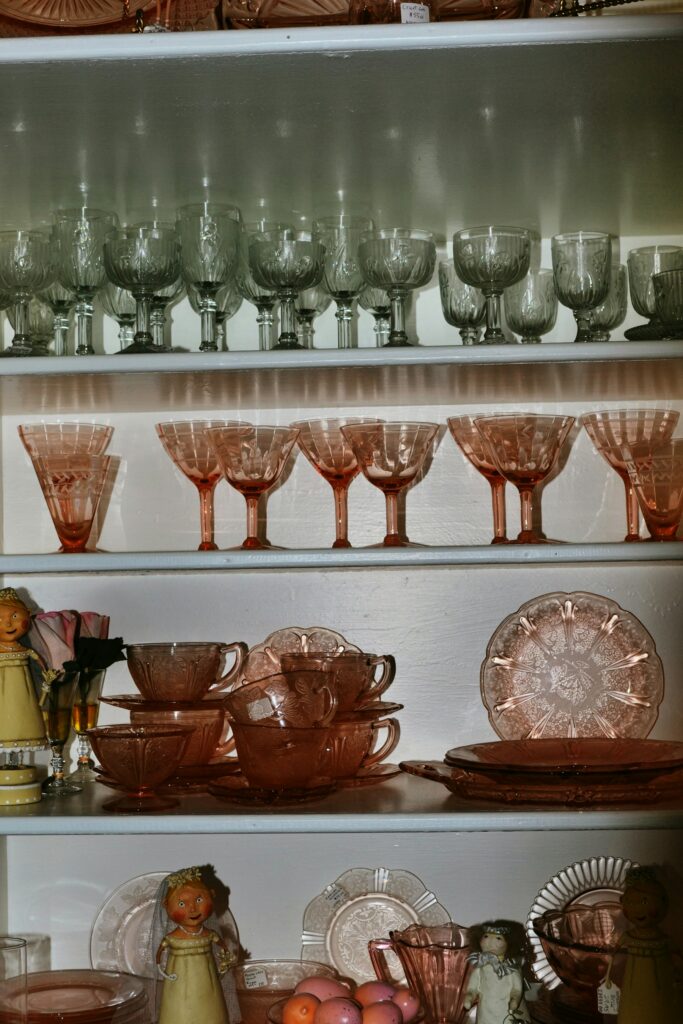
A shelf of colored vintage glassware

Uranium glass: the piece that glows

Uranium glass contains a small amount of uranium oxide, which gives it a yellow-to-green color. Under ultraviolet light it glows a bright, unmistakable green. It was especially popular in the late 1800s and early 1900s.

Vaseline glass is a type of uranium glass with a pale yellow-green, slightly oily look. That is where the name comes from. In short, Vaseline glass is usually uranium glass, but not all uranium glass is Vaseline glass.

The one tool you need: a UV flashlight

A small UV (blacklight) flashlight costs about ten dollars and settles most questions in seconds. Take it into a dark room and shine it on the glass:

  • Bright green glow: uranium glass, including Vaseline glass and some green Depression glass.
  • No glow: most pink, amber, blue and clear Depression glass.

That overlap matters. A green Depression-era dish can contain uranium, so the UV test is the only easy way to tell.

Is uranium glass safe?

The amount of uranium is small, and collectors generally treat it as safe to own and display. If you are unsure, use it as a decorative piece rather than for food.

What makes it valuable?

Pattern, color, rarity and condition drive price. Single common pieces are usually modest. Complete sets, rare colors and pieces with no chips sell best. Run a fingertip gently around every rim to feel for chips before you price anything.

From Blue Leaf

Have a cabinet full of colored glass?

We sell estates and collections across Arizona through live and online auctions. Every piece is photographed, cataloged and sold item by item to the highest bidders. Call 602-758-0865 for a free consultation, or browse our online auctions.

Sources

  • Southern Crush at Home: Uranium, Vaseline and Depression glass
  • Appraisily: How to identify Vaseline glass

Filed Under: Collecting Guides

  • « Previous Page
  • 1
  • 2
  • 3
  • Next Page »

Email Newsletter

Join our email updates and hear about our upcoming estate sale auctions.

Search

What we sell at auctionSee all categories
Blue Leaf Auctions & MarketingLive and online estate auctions across Arizona, based in Phoenix. Sold in one day, with an itemized settlement for every sale.
Call 602-758-0865
Auctions
  • Live Auctions
  • Online Auctions
  • Sell With Us
  • Areas We Serve
  • Fiduciary Services
  • Realtor Services
  • Charity Auctions
Connect
  • Contact Us
  • Facebook
  • Pinterest
  • Instagram
  • bleauctions@gmail.com
  • Se habla español
© 2026 Blue Leaf Auctions & Marketing · Serving all of Arizona